

Your Digital Rights 101
Your rights don’t stop when you go online. Just like you have the right to safety, privacy, and freedom of expression offline, those same rights apply in digital spaces. Yet, too often people in South Africa are unaware of what digital rights mean — or how to defend them. This guide breaks down your key digital rights and how they affect your daily life online.
What Are Digital Rights?
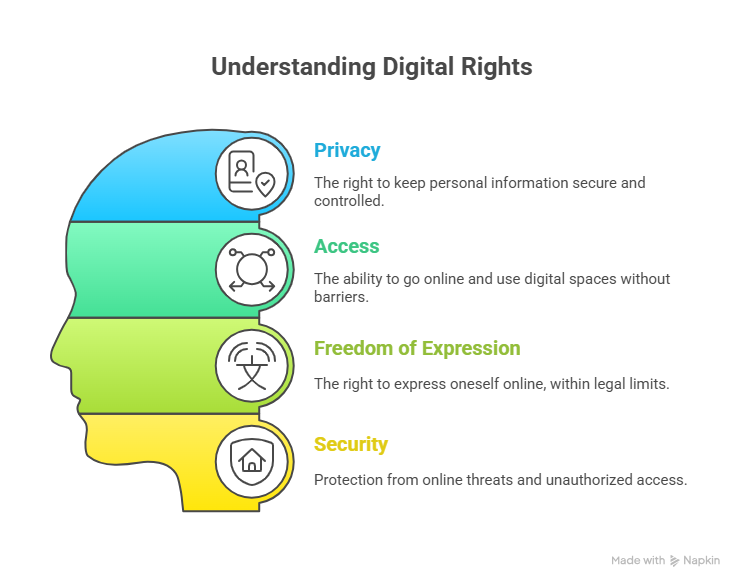
Digital rights are simply the application of your human rights in the online world. When you go on the internet, use social media, message someone, or share content — the rights you have offline should carry over. Let’s unpack some of the most important ones in plain English:
Privacy
This means you have the right to keep your personal information, communications and online activity secure and not unduly exposed. When you share your details, the people receiving or storing them must respect your control over what’s shared, why, and with whom.
Access
Having access means being able to go online, use the internet, communicate and share ideas. It also means that you are not unfairly blocked or locked out of digital spaces because of who you are, where you live, or your income.
Freedom of Expression
Just as you can speak, write or protest offline, you should also be able to express yourself online — share your views, join discussions, connect with others. Of course, this right is not unlimited (for instance you can’t incite violence), but it’s a key part of being digital.
Security
Security relates to keeping your online presence and data safe from theft, hacking, unauthorised access, blackmail, or other harms. You should have the tools and protections to defend your digital self.
These rights overlap — for instance, without access you cannot freely express yourself; without security your privacy may be at risk. Recognising them helps you understand when your rights are being respected or ignored.
What the Law Says — South Africa’s Framework
In South Africa, there are specific laws and frameworks that help protect digital rights. Here are the major ones you should know about:
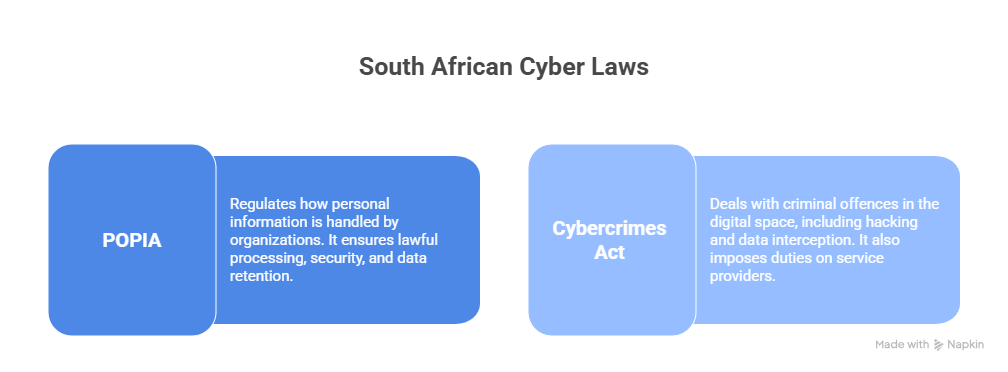
Protection of Personal Information Act (POPIA)
POPIA is the primary law that regulates how personal information must be handled by organisations (both public and private). It says that if someone collects or processes your personal info (for example your name, ID, contact details, or other identifying data), they must do so lawfully, with your knowledge or consent (in many cases), and must take appropriate steps to keep it safe. Some of the core requirements of POPIA include: processing personal info fairly and lawfully, for a specified purpose; ensuring security safeguards; not keeping it longer than necessary; and putting in place measures to prevent loss or misuse. For you as an individual, this law means you have rights: to know what information is collected about you, to ask for corrections, and to be notified of data breaches in certain circumstances.
Cybercrimes Act (Act 19 of 2020)
This law deals with criminal offences in the digital space: hacking, unlawful interception of data, distribution of harmful digital content, and so on. More specifically, it criminalises acts such as unlawful access of a computer system, interception of data, interference with computer programs, acquisition/use of passwords without authorisation, malicious communications, revenge pornography, etc. It also imposes duties on service providers (in certain circumstances) to preserve data and report offences.
How they work together
POPIA and the Cybercrimes Act complement each other: POPIA is about protecting your personal data and ensuring lawful processing; the Cybercrimes Act is about punishing misuse, attacks and malicious behaviour in the digital space. There are also other frameworks and policies (for example the National Cyber Security Policy Framework) that set out how the country intends to build cyber-security and regulate digital access.
What this means for you
Organisations must handle your personal data in a way that follows POPIA.
If someone illegally hacks your account, steals your data, or spreads harmful content about you, you may have recourse under the Cybercrimes Act.
The laws also mean that you are not powerless: you have rights and you have avenues to challenge abuse.
Why They Matter to You
Let’s get concrete — how do these rights, and their protections, affect your daily online life in South Africa?
Data leaks and personal information
Imagine you signed up for an online service and gave your phone number, ID number or bank details. If that service is careless and your data gets leaked or stolen, your privacy is breached. POPIA says that such personal information must be protected and you should be notified in many cases. If it isn’t, you may have a claim. Also, if your identity is stolen or your account is hacked, the Cybercrimes Act (along with other laws) may provide a route to hold the perpetrator liable.
Online harassment, revenge-porn or harmful content
If someone shares intimate images of you without your consent, or uses digital platforms to bully or defame you, these are real threats to your freedom of expression and safety. The Cybercrimes Act specifically criminalises “malicious communications” and similar offences.
It means you are not on your own and that there are legal protections and ways to seek help.
Digital divide and access
Even though this is less about law and more about practical reality: if you don’t have reliable internet access, affordable devices, or digital literacy, then your digital rights (to access, to express yourself) are limited in practice. Reports on digital rights and inclusion in South Africa note the digital divide remains a barrier.
Censorship, surveillance and expression
Your freedom to express yourself online matters. If state or corporate actors impose excessive restrictions, monitor your communications without justification, or block your access unjustifiably — that’s a digital-rights issue. While SA generally has decent freedom of expression protections, there are concerns about regulatory proposals and digital surveillance. Remember, your digital rights are the backbone of a fair, safe and open online world. When they’re ignored or violated, you may feel powerless, misinformed or vulnerable. Knowing them gives you power.
How to Claim Your Rights
Here are practical steps you can take to protect and assert your digital rights. These are things you can do today and keep doing.
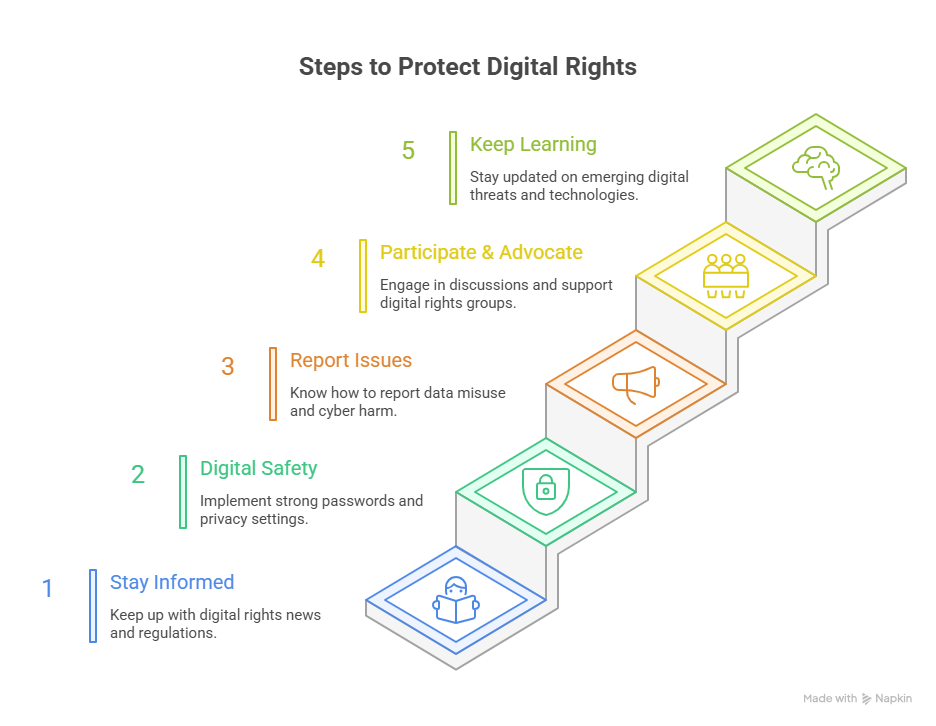
1. Stay informed
Follow civil-society groups, legal clinics and digital-rights organisations that publish guidance and updates on digital rights.
Read about your rights under POPIA and the Cybercrimes Act, it’s your entitlement to know.
Keep up with news about digital access, internet shutdowns, or new regulations in South Africa.
Follow civil-society groups, legal clinics and digital-rights organisations that publish guidance and updates on digital rights.
Read about your rights under POPIA and the Cybercrimes Act, it’s your entitlement to know.
Keep up with news about digital access, internet shutdowns, or new regulations in South Africa.
2. Take basic digital-safety steps
Use strong, unique passwords for accounts.
Turn on two-factor authentication where possible.
Be cautious about what personal information you share online, especially in public forums or social media.
Monitor your privacy settings on social media platforms and apps.
If you encounter a data breach (your account hacked, someone obtained your data), document what happened and consider reporting it.
Use strong, unique passwords for accounts.
Turn on two-factor authentication where possible.
Be cautious about what personal information you share online, especially in public forums or social media.
Monitor your privacy settings on social media platforms and apps.
If you encounter a data breach (your account hacked, someone obtained your data), document what happened and consider reporting it.
3. Know how to report issues
If your personal information was mis-used by a business or organisation (for example they shared it without your consent, they leaked it, or processed it unlawfully), you can lodge a complaint with the Information Regulator — the body established under POPIA to enforce it.
If you’ve been affected by cyber-harm (hacking, harassment, malicious digital communications), you may approach the police (via the South African Police Service) or another law-enforcement body under the Cybercrimes Act. Document evidence (screenshots, dates, messages) because it strengthens your case.
When you see unfair or suspicious online practices (for example hidden costs, data harvesting without clear consent, or digital access blocks), you can contact consumer-protection bodies, rights organisations, or get legal advice.
If your personal information was mis-used by a business or organisation (for example they shared it without your consent, they leaked it, or processed it unlawfully), you can lodge a complaint with the Information Regulator — the body established under POPIA to enforce it.
If you’ve been affected by cyber-harm (hacking, harassment, malicious digital communications), you may approach the police (via the South African Police Service) or another law-enforcement body under the Cybercrimes Act. Document evidence (screenshots, dates, messages) because it strengthens your case.
When you see unfair or suspicious online practices (for example hidden costs, data harvesting without clear consent, or digital access blocks), you can contact consumer-protection bodies, rights organisations, or get legal advice.
4. Participate and advocate
Speak about digital rights — with friends, in your community, at school or in work. Encourage digital literacy and rights awareness.
Join, or support, groups working for better internet access, stronger data protections, affordable devices, digital inclusion.
When new laws or regulations are proposed (for example by government or large companies), pay attention because public participation and civic oversight matters. Your voice counts.
Use your rights: access the internet, create content, engage online responsibly. Exercising the right to expression strengthens everyone’s digital space.
Speak about digital rights — with friends, in your community, at school or in work. Encourage digital literacy and rights awareness.
Join, or support, groups working for better internet access, stronger data protections, affordable devices, digital inclusion.
When new laws or regulations are proposed (for example by government or large companies), pay attention because public participation and civic oversight matters. Your voice counts.
Use your rights: access the internet, create content, engage online responsibly. Exercising the right to expression strengthens everyone’s digital space.
5. Keep learning and adapting
The digital world evolves fast. New technologies, new apps, new kinds of data-use (like AI, biometrics, surveillance-tools) mean new challenges. Keep revisiting your knowledge, learn about emerging threats (for example deep-fakes, algorithmic bias, data-profiling) and how rights adapt.
The Future of Digital Freedom
Looking ahead, your role as a digital citizen in South Africa is more important than ever. Here are some things to keep an eye on, and ways you can be part of shaping a better digital future.
Empowerment through knowledge
The more people know their digital rights, the stronger those rights become. A society where everyone can safely access, express, and participate online is a healthier democracy. Civil society research shows that the right to information, privacy and expression are already being mapped and litigated at scale in southern Africa.
Inclusion and closing the digital divide
Digital rights only matter if people can access and use the internet meaningfully. That means affordable devices, decent connectivity, digital-skills education, and access in rural/underserved areas. If we don’t close that gap, many young people will be left behind.
Emerging challenges
Algorithmic decision-making & AI: who controls your data, how decisions are made (like credit scoring, hiring, policing) and what safeguards exist?
Surveillance and digital tracking: As governments and companies deploy more digital tools, the risk to privacy and freedom of expression grows unless robust safeguards exist.
Cross-border data flows & digital sovereignty: Because data often travels across borders, international frameworks and enforcement matter. South Africa’s laws are evolving to address these issues.
Your role in shaping it
Speak up when you see unfair digital practices or barriers.
Vote with your voice (and your device): support companies and platforms that respect rights.
Educate peers and younger users to understand digital safety and rights.
Stay alert to new laws, engage in public consultations, and help hold decision-makers accountable.
Your digital rights may seem abstract, but they affect your everyday online life from posting on social media, sending messages, using apps, to trusting that your personal info is handled properly. In South Africa, a growing legal framework supports these rights, and you have the power to make them real. Stay informed. Stay safe. Use your voice. Because digital freedom isn’t just for tomorrow, it begins right now.